Take a fortnight off. Not a working holiday with the laptop open at breakfast. Two weeks where nobody can reach you.
Most owners cannot answer that without a knot in the stomach, and the knot is not about the holiday. It is the quiet knowledge that approvals wait for you, quotes wait for you, follow-ups happen when you remember them, and the management report gets pulled when you ask twice. Twenty years of judgement lives in your head, written down nowhere.
There is a name for this. Business valuers call it owner dependency, and they care about it because it is the single biggest discount applied to a business at sale. A company that stops when one person stops is worth less than the same company that keeps running.
The standard advice for fixing it has been the same for thirty years: document your processes, delegate with accountability, build a management team, step back gradually. It is good advice. It is also slow, expensive, and most owners reading this have already tried some version of it and are still the bottleneck.
What has changed is that the work itself can now be done by systems you build and own. Not delegated to people you hire. Done by systems. That is a different answer to a very old problem, and almost nobody in the owner-dependency conversation is giving it.
Why did 95% of AI pilots return nothing?
Quick Answer: Because almost everyone bought tools instead of building systems. Adoption is close to universal and returns are close to zero: 89% of small businesses now use AI in some capacity, up from 36% in 2023 (U.S. Chamber of Commerce, 2026), while roughly 95% of generative AI pilots deliver no measurable profit impact and 42% of firms have abandoned most of their AI work (reported by Forbes, 28 July 2026).
Sit with those two numbers together, because the gap between them is the entire subject of this piece. Nine businesses in ten are using AI. One in twenty is getting anything out of it that shows up in the accounts.
That is not a technology failure. Around 70% of AI transformations are reported to fail for organisational reasons rather than technical ones. The tools work. What is missing is the thing the tools are supposed to be part of.
I should be straight about the figures: those are largely US datasets, and I have not seen an Indian equivalent with the same rigour. The pattern in the rooms I stand in front of is identical, but treat the precise percentages as directional rather than local.
Here is what the failure actually looks like, because I have watched it happen a hundred times. An owner opens ChatGPT, types a question about their business, gets an answer that could apply to any business on earth, tries twice more, and quietly stops. They conclude AI is overhyped. What actually happened is that they asked a stranger a question about a company it knows nothing about, and got a stranger's answer.
Your first action: count the AI subscriptions your business pays for, then name the one business function that runs differently because of them. If you cannot name one, you have tools, not a system.
What is an AI operating system for a business?
Quick Answer: An AI operating system is a connected set of AI systems that run your business's actual functions, rather than a collection of tools you open when you remember to. The distinction is not size or spend. A tool does a task when prompted. A system runs a function whether or not you are watching.
That sentence is the whole idea, and it is worth reading twice, because almost everything sold as AI training in India teaches the first half and calls it the second.
A prompt library is a tool. A course on writing better prompts is training in tools. A folder of clever prompts you dip into on a Tuesday is still you doing the work, just faster. None of it survives you taking a fortnight off, which means none of it touches owner dependency at all.
A system is different in one specific way: it has a job, it holds the context it needs to do that job, and it runs on a trigger that is not you remembering.
A tool does a task when prompted. A system runs a function whether or not you are watching.
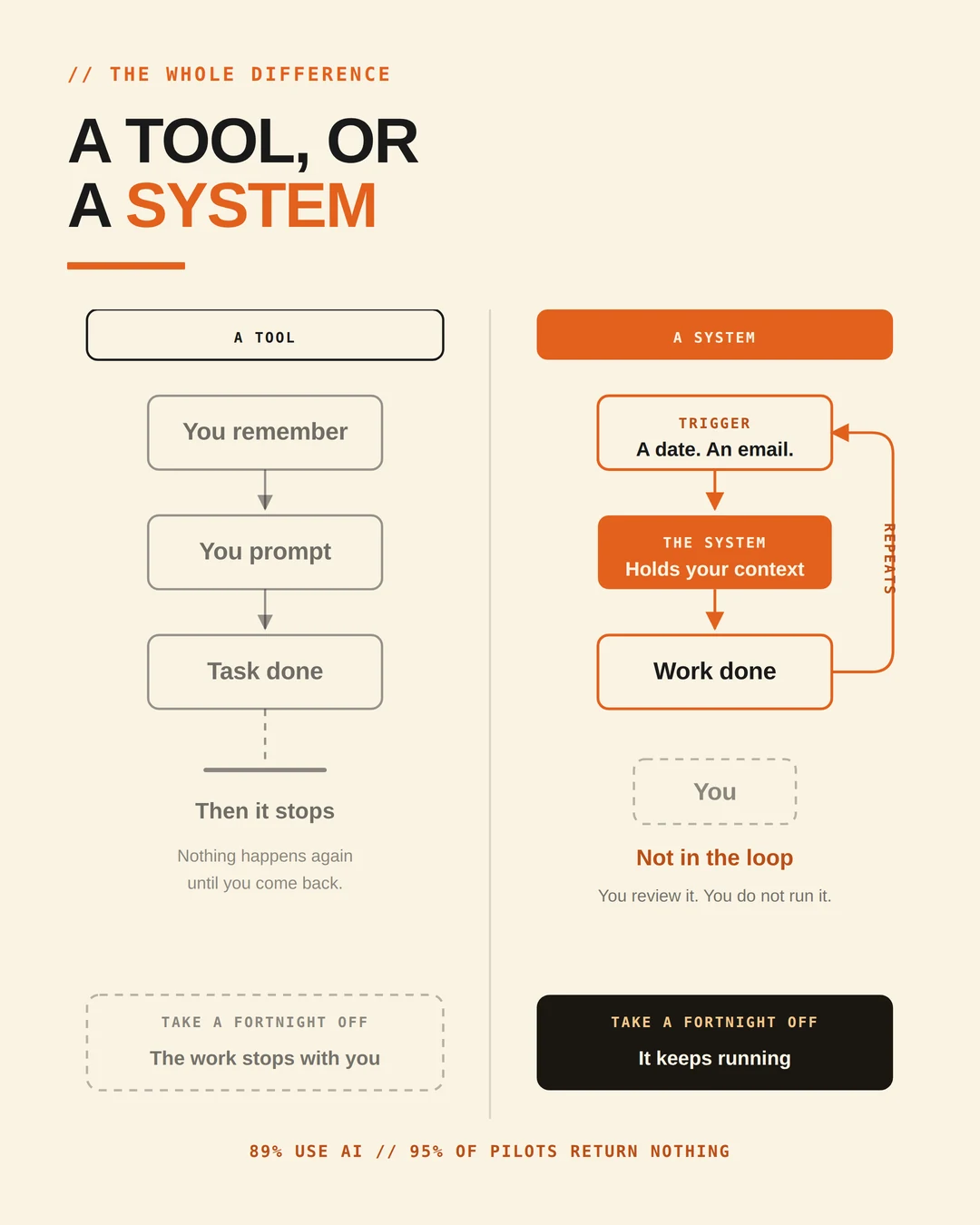
I call the connected version of this an AI operating system, or AIOS. I should be honest that this is my term rather than an industry standard. The reason I use it is that "operating system" is the only phrase that carries the right idea: not an app you open, but the layer everything else runs on.
Your first action: take the last thing AI did well for you and ask whether it would have happened if you had been unreachable that day. That answer tells you which of the two you have.
Why is an org chart the right model for it?
Quick Answer: Because it is the only structure every business owner already understands, and because the mistake most people make is picturing AI as a very fast employee rather than as a department that never sleeps. Map the system onto the chart you already run and the design questions answer themselves.
Here is the model I build with every client:
- You are the CEO. You set direction, make the judgement calls that need a human, and approve what matters. That does not change, and any AI pitch that says it will should worry you.
- Claude Cowork is the General Manager. It holds the context of the whole business and acts across it: reads, decides, drafts and delegates on your behalf. This is the piece almost nobody has, and its absence is why most AI use stays stuck at the level of asking questions one at a time.
- Claude Skills are your department heads. One for sales, one for marketing, one for operations. You build each one once, on your own business, in your own language and your own pricing, and it works the same way every time after that.
- Plugins turn a department head into a full department. The skill knows how you write a proposal. The plugin connects it to your CRM, your pricing and your calendar so it can produce one end to end.
- Scheduled automations are the night shift. The work that happens while nobody is in the building. Reports compiled, follow-ups sent, pipelines updated, all before you open your laptop.
- Notion is the command centre. Every project, client and automation on one dashboard, so you can see what the system did without asking it.
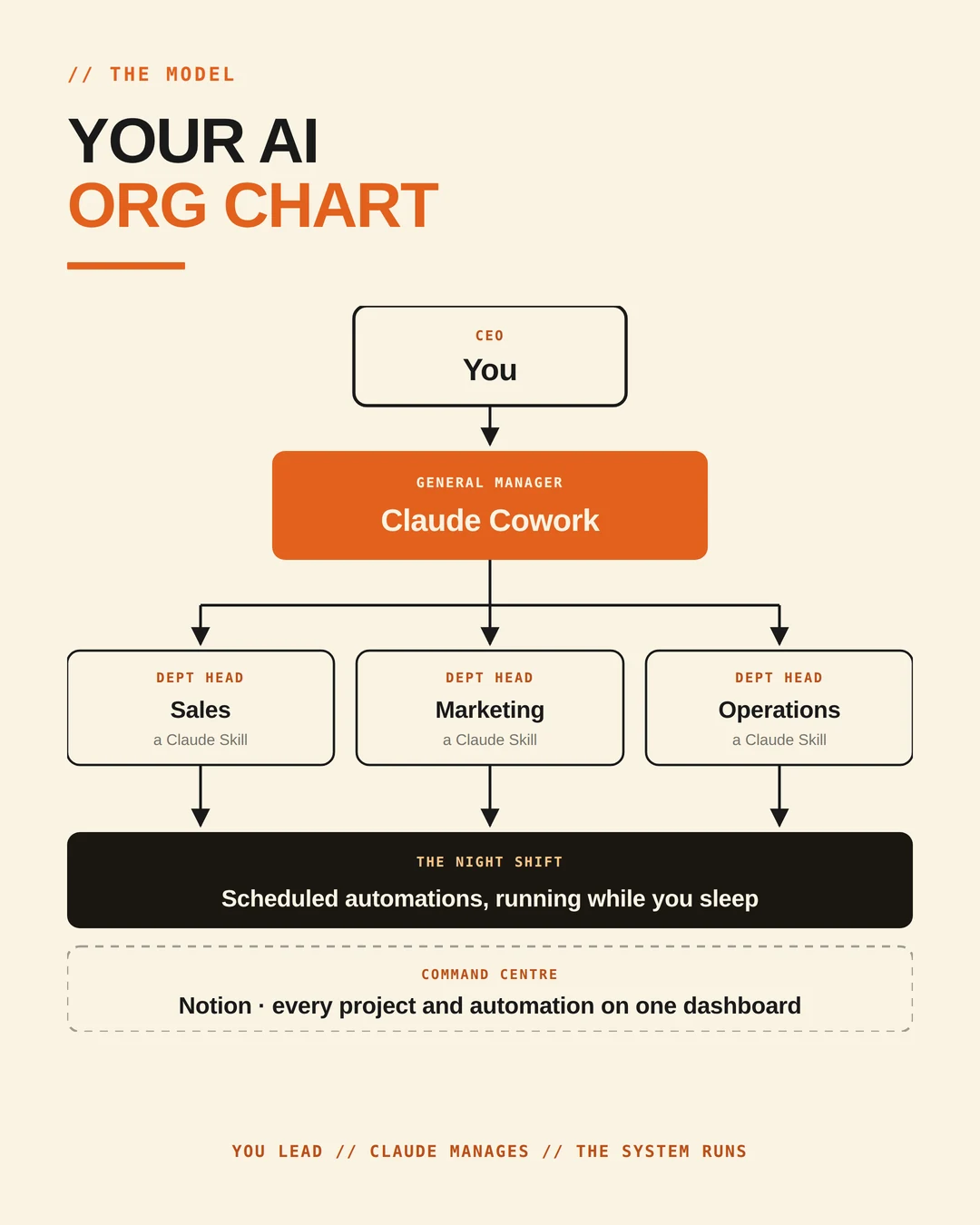
The org chart is not a metaphor I reach for because it sounds good. It is diagnostic. Look at your own business through it and the gaps are immediately obvious: most owners who think they have an AI problem actually have no General Manager and four department heads that are really just saved prompts.
Your first action: draw your business as that chart on one sheet of paper, and mark which boxes are currently filled by you personally. Those are your build targets, in order.
What does an AI operating system look like when it is running?
Quick Answer: Concrete, boring and measurable. The examples below are all clients of mine, named, and every number has been seen by the person it belongs to before it was published. None of them wrote code.
Ashit Vora, electrical contractor, age 64. He built three systems: a material management bot, a monthly MIS that went from seven days to fifteen minutes, and an AI-run performance review. Together they save him over 60 hours a month and describes himself as his company's Chief AI Officer, which was his phrase, not mine. He had never written a line of code and had no interest in starting.
Prakash Patil, GST consultant. The report behind every client visit took seven to eight days. It now takes five minutes. The important part is what that did to the business rather than to the calendar: he moved from two client visits a month to two client visits a week, all billable, which is roughly four times the capacity. Capacity was the constraint, and the system removed it.
Nelson Fernandes, sales trainer. Builds a custom proposal in fifteen minutes. Closed a ₹48 lakh corporate contract with one of them.
Rajesh Nagjee, CEO coach in Dubai. Rebooted his coaching business on the system and reported $190,000 in seven weeks through AI-powered positioning, proposals and content.
Notice what none of those are. Nobody says "I found a great prompt." Every one of them describes a function of the business that now runs differently, permanently. That is the difference between the 5% and the 95%, and it is a difference of structure rather than of effort or intelligence.
Your first action: pick the single task in your business that eats the most of your week and is the most repetitive. That is your first system, not your tenth.
Why build it on Claude rather than ChatGPT?
Quick Answer: Three practical reasons, and I am not neutral here: both my programmes were originally built on ChatGPT and custom GPTs, and I rebuilt everything on Claude. That was an expensive decision, so it is worth explaining rather than asserting.
Context that spans the business. Claude Cowork can hold the whole picture and act across it, rather than answering one question at a time in a window that forgets you tomorrow. A General Manager who has to be re-briefed every morning is not a General Manager.
Skills and plugins a non-technical owner can actually build. You build a department head once and run it forever. The alternative is re-prompting from scratch every time, which is the treadmill most people mistake for using AI.
Scheduled automations that run inside the same place. The night shift runs in Claude itself, so there is no separate automation platform to pay for, learn and maintain. For a business with no technical team, one fewer moving part is worth more than it sounds.
The honest caveat: this is a judgement about fit for a specific job, which is running a small or mid-sized business without a technical team. It is not a claim that one model is cleverer than another, and anyone who tells you the answer is permanent is selling something. What I can tell you is that the systems held together without me in the room after the rebuild, and did not before.
Your first action: before you switch anything, name the one function you want running by itself in 90 days. Choose the tooling to fit that, not the other way round.
Do you need to be technical to build one?
Quick Answer: No, and if a programme requires you to be, it is built for the wrong person. The reference case is Ashit Vora, who was 64, had never coded, and built his own reporting system during live sessions on his own business data.
This is the objection I hear most, and underneath it is usually a different worry: not "can I learn this" but "will I look foolish trying." Fair enough. So use the test that settles it. If a 64-year-old electrical contractor with no coding background built a reporting system that saves him 60 hours a month, the question of whether you can is mostly settled. What is left is whether you will protect the hours.
There is a related mistake that costs more than it looks. Owners delegate AI to a junior, because it seems like a tools problem and juniors are good with tools. A junior can operate a tool. Redesigning how a business runs is owner's work, because it requires the twenty years of judgement that lives in your head and nowhere else. That is precisely the asset you are trying to get out of your head and into a system, and it cannot be delegated to someone who does not have it.
Your first action: block four hours a week in your calendar before you buy anything. If you cannot protect them, no programme on earth will help, and you have saved yourself the money.
Where should you start?
Quick Answer: With one function, not one tool. Pick the thing that eats your week, has a repeatable shape, and does not need your judgement every time. Build that as a system, prove it runs without you, then build the next one.
The order matters more than the speed. Owners who try to build the whole operating system at once end up with nothing running. Owners who get one function genuinely off their desk get two things: the hours back, and the pattern. The second one is worth more, because it makes every system after it faster to build.
Three checks to run before you commit to anyone's help with this:
- Do they run their own business on what they teach, or only demonstrate it?
- Do they guarantee systems live in your business, or lessons delivered? Most AI training in India is built for employees and guarantees a salary, a job or a certificate. Those are good offers, for employees. You sign the salaries and carry the P&L.
- Do you own and understand what gets built, or are you renting access to someone else's tool? If the systems leave when the engagement ends, you have bought a service, not an operating system.
I have been in business for 25 years and mentoring business owners since 2004, when I started BNI India and grew it from zero to more than 10,000 entrepreneurs across 28 cities. I have used AI daily since December 2022. The reason I put those two facts next to each other is that the work only holds together where business, AI and systems meet. An operating system for your business cannot be designed by someone who has never run one.
Your first action: go back to the fortnight. Write down the five things that would break. Those five are your operating system, in build order, and you now know more about what to do next than most people who have spent a year reading about AI.
FAQ
My business depends on me for everything. Can AI actually fix that?
Partly, and the part it fixes is larger than most owners expect. Business valuers call this owner dependency, and the traditional fix is to document processes, delegate and hire a management team, which is slow and expensive. The alternative now available is to build systems that do the work themselves: a sales proposal system, a reporting system, a follow-up system, each running on a trigger that is not you remembering. What AI cannot replace is the judgement you apply to exceptions, and any programme claiming otherwise should worry you.
What is the difference between an AI tool and an AI system?
A tool does a task when prompted. A system runs a function whether or not you are watching. A prompt library, however good, is still you doing the work faster, which means it disappears the moment you take two weeks off. A system holds the context it needs, has a defined job, and runs on a trigger. That distinction is why 89% of small businesses use AI (U.S. Chamber of Commerce, 2026) while roughly 95% of AI pilots return nothing measurable (reported by Forbes, 28 July 2026).
Should I learn AI myself or hire someone to run it for my business?
Learn it yourself, and this is the mistake that costs owners the most. Delegating AI to a junior looks sensible because it appears to be a tools problem, and juniors are good with tools. But redesigning how a business runs requires the twenty years of judgement that lives in your head and nowhere else. That judgement is precisely the asset you are trying to move out of your head and into a system, and it cannot be delegated to someone who does not have it.
How long does it take to get an AI system actually running in a business?
One function, properly built, takes weeks rather than months. A connected operating system across marketing, sales and operations is a six-month build. In my own programme the written guarantee is five AI systems live in the business within 90 days, on the client's own data, built by the client. The order matters more than the speed: owners who try to build everything at once end up with nothing running.
Is AI training for business owners different from AI training for employees?
Completely, and it is worth checking which one you are being sold. Most AI training in India is built for employees and guarantees a salary, a job or a certificate. One of the largest promises a 200% refund if you do not land a role worth 18 LPA. Those are good offers, for employees. If you sign the salaries and carry the P&L, you do not need a certificate. You need the business to run without you in every seat, which is a different outcome and a different build.
Do I need to be technical or know how to code to build AI systems?
No. The reference case in my own client base is Ashit Vora, a 64-year-old electrical contractor who had never written a line of code, and who built his own reporting system during live sessions on his own business data. It cut a report that took a full week down to fifteen minutes and saves him over 60 hours a month. What the work does require is four to six hours a week that you can genuinely protect.
If you want to see how this gets built, Titan AI Business Mastery installs the full operating system over six months, with five AI systems live in your business within 90 days, guaranteed. If client acquisition is the function you want running first, Unlock LinkedIn with AI installs that department on its own in 12 weeks. Not sure which, or whether either: book a call and I will tell you straight, including when the answer is neither.