I have reinvented myself four times in eleven years. Plastics manufacturer to networking expert. Networking expert to business coach. Business coach to LinkedIn expert. LinkedIn expert to AI expert. Every one of those was forced on me, not chosen, because the ground moved faster than the playbook I was holding.
In December 2022 a friend in London showed me ChatGPT. He built a marketing campaign in thirty minutes that had taken me two days the week before. I spent the next ninety days learning to prompt, two to three hours a day, and came out of it with a lead magnet, a landing page, an email sequence and 350 customers from a product I launched in a fortnight.
That was the easy shift. The harder one came this year, when I moved my whole operation onto Claude Cowork and found that almost everything I had learned about prompting was the wrong skill.
This is what I would tell you if you sat down opposite me. It is not a tool list. The tools are in a separate piece because they change every few months and this does not.
How fast is AI actually changing business?
Quick Answer: Faster than any single skill can keep up with. Ray Kurzweil predicted in 2001 that this century would deliver 20,000 years of progress at twentieth-century rates. Peter Diamandis puts it more conservatively: a century of progress every decade. Either estimate breaks the assumption that you learn a craft once.
For most of history you could learn a trade, get good, and ride that competence for thirty years. That arrangement has gone.
Ray Kurzweil made the original case in his 2001 essay The Law of Accelerating Returns: "we won't experience 100 years of progress in the 21st century, it will be more like 20,000 years of progress." Peter Diamandis, speaking to CNBC in March 2024, gives the conservative version: as much progress in the next ten years as in the last hundred. Take whichever you find easier to believe. Both describe a world where the useful life of what you know is shorter than your career.
The employment numbers say the same thing more bluntly. American employers announced 1,206,374 job cuts in 2025, up 58 percent on the year before and the highest since 2020, while announced hiring fell to 507,647, the lowest since 2010. January 2026 was the worst January since 2009. Those are Challenger, Gray and Christmas figures, and they are American, so treat them as direction rather than as a forecast for Mumbai. The direction is what matters: cuts at a five-year high, hiring at a fifteen-year low, in the same twelve months.
Worth noticing what the data does not say. AI was explicitly blamed for only about seven percent of January's cuts. This is not machines firing people. It is companies restructuring around what machines now do, which is slower, quieter and much harder to argue with.
Your first action: write down the three things your business does today that you would bet money still look the same in eighteen months. Whatever is not on that list is your working queue.
Will AI replace me, or will it replace my competitor?
Quick Answer: Neither, directly. Karim Lakhani of Harvard Business School put it best in 2023: AI will not replace humans, but humans with AI will replace humans without AI. The threat is not the technology. It is the person in your market who spent six months getting good at it.
Sachin Tendulkar was not the greatest batsman of his generation because he hit the ball harder. He batted where the ball was going rather than where it was. He was two steps ahead of the delivery, every time.
That is the whole game now, and it is worth being precise about who you are actually competing with. Not the model. The consultant down the road who has spent six months learning to use it properly, is doing your work in a fraction of the time at higher quality, and is spending the hours he saves on the things you keep promising yourself you would do if the days were longer.
The founders who understand this fastest are almost always the ones who have already been late to something once. They know the feeling. They are not interested in a repeat.
Your first action: find one person in your market who is visibly ahead of you on this and read their last month of output properly. Not to copy it. To calibrate how far ahead is actually possible.
Where should I actually use AI in my business?
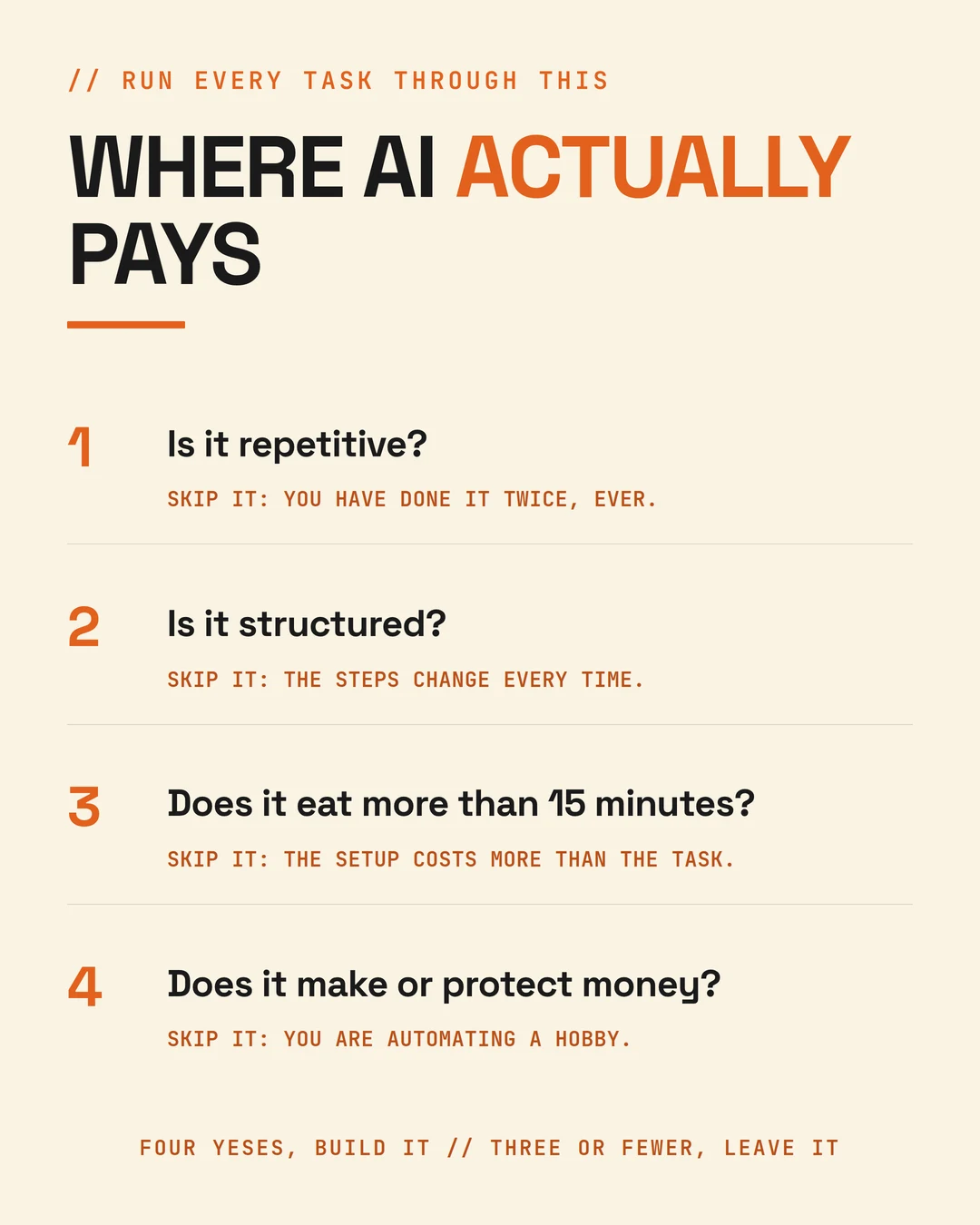
Quick Answer: Run every recurring task through four filters. Is it repetitive, is it structured, does it take more than fifteen minutes a time, and does it make or protect money? Four yeses means start there. Two or three can wait. One yes is usually not worth automating at all.
"I do not know where to apply AI in my business" is the most common sentence I hear, and it is not a question AI can answer for you. It is a diagnostic question, and it has a boring, reliable answer.
- Is it repetitive? Are you or your team doing the same shape of work again and again?
- Is it structured? Clear input, clear output, clear steps between them.
- Is it time-consuming? More than fifteen minutes an instance, often enough that the hours add up.
- Does it make or protect money? Either directly, through proposals, lead generation, content that puts you in front of buyers, or indirectly by giving you back hours you would spend on those things.
Ashit Vora was 64 when he joined the programme, an electrical contractor running projects between one crore and twenty crores, with no coding experience of any kind. When he ran his business through those four filters with his team, the winner was not glamorous.
On every site his ground team took delivery of expensive materials and wrote up the notes by hand, sometimes in Marathi, sometimes Hindi, sometimes Gujarati, sometimes English. Somebody in the office then spent three hours a day photographing those notes, typing them up and updating a Google Sheet so Ashit could see what had arrived and what had been used. Repetitive, structured, twenty-one hours a week, and every untracked delivery was margin walking out of the door.
He built a Telegram bot the ground teams could send photos to. It read the notes in any of the four languages, translated them, updated the sheet, and pinged the office only when something was genuinely unclear. More than forty hours a month back, from the first workflow.
Then he ran the test again. Next was the monthly management report his accounts team pulled out of Tally, eleven files, one full week of work. That report now takes fifteen minutes.
Your first action: list ten tasks that happen in your business at least weekly and mark each one against the four filters. Circle the four-yes rows. That is your queue, in order.
How should I think about AI, if not as a chatbot?
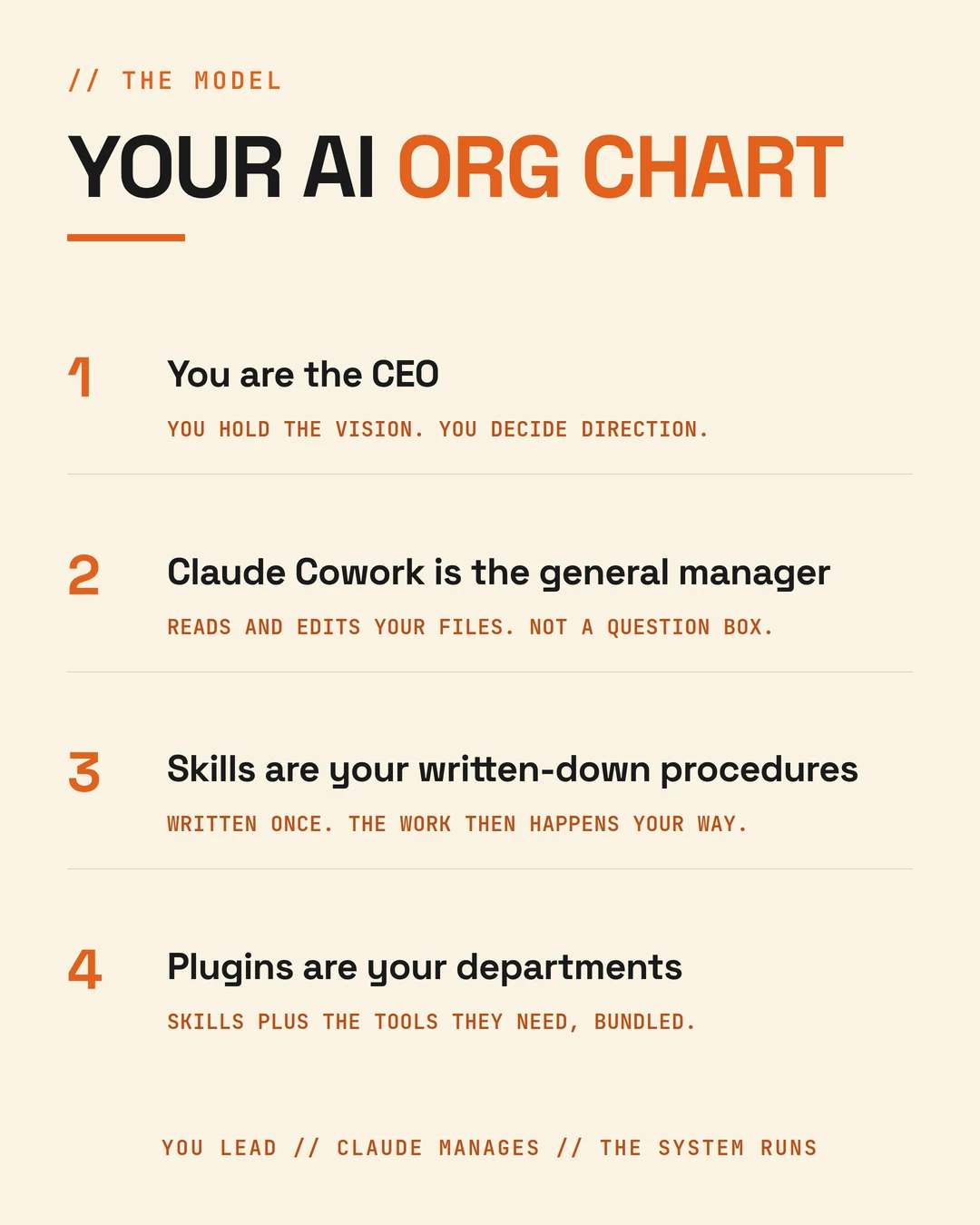
Quick Answer: As an organisation chart. You are the CEO. Claude Cowork is your general manager. Skills are your standard operating procedures, written down once. Plugins are your departments. The question stops being what to ask the AI and becomes which part of your business needs a department.
If you take one thing from this piece, take this one.
Most people are still thinking in prompts. They open a chat window, type a question, copy the answer, paste it into a document, and call that using AI. That is a search engine that talks back. It is useful. It is not a system, and it will never run anything while you sleep.
The model that works is the org chart you already understand.
You are the CEO. You hold the vision, you decide direction, and you spend your time on the handful of things nobody else can do.
Your AI is the general manager. Not a question-answering box. It reads and edits the files on your machine, connects to your Drive, your Notion, your calendar and your inbox, and moves work between them without you copying anything.
Skills are your standard operating procedures. The way you write a proposal, qualify a lead, draft a post. Each one written down once, as a plain text file. From then on the work happens your way rather than a generic way.
Plugins are your departments. A marketing plugin holds every marketing skill plus the tools marketing uses. Sales the same. Finance the same. Each behaves like a trained team member who already knows your processes.
Last month I ran an event campaign this way. Cowork built the calendar, knew I send email through GetResponse, drafted every email, WhatsApp message and post in my voice, generated the links and updated the command centre as the campaign ran. By week two there were 295 registrations and a report that wrote itself. I was not asking for help with a campaign. I was reviewing the decisions only I could make while the rest ran.
Your first action: take the single task you do most often and write down the steps you actually follow, in order, in plain English. That file is your first skill.
Why does AI keep giving me generic advice?
Quick Answer: Because it does not know anything about your business, and you are re-explaining from scratch every session. The fix is not better prompts. It is a folder of files describing your offers, customers, goals, tools and voice, which the AI reads before you say a word.
Imagine having to re-explain who your customers are, what you sell and which software you run every single time you spoke to a colleague. Nothing would get done. That is what most people do with AI every day.
Building the context folder is unglamorous and it is the step that separates the founders who get somewhere from the ones who conclude the whole thing is overhyped. The offers you sell. The customers you serve. What you have already tried and what happened. The year's goals. Your tech stack. How you write. How your visuals look.
You sandbox that folder, so the AI reads what you point it at and nothing else on your machine. Then every session starts with it already knowing that your CRM is Folk, your email is on Outlook, your visual style is the cream notebook look, and that you write in British English without exclamation marks.
The difference in output is not subtle. Before, you get advice that would suit anybody. After, you get advice calibrated to your business. Almost everyone who tells me they tried AI and it did not stick failed at exactly this step. They were prompting into a void.
Your first action: create a folder called context and put one file in it, a plain English description of your business, your offers, your customer types and the tools you use. One file is enough to start.
How do I avoid being locked into one AI model?
Quick Answer: Keep your business in plain text files rather than inside one product's chat history. Markdown opens in Notepad and will still open in ten years. When a better model arrives, you point it at the folder and you are running again inside an hour instead of starting over.
The model winning today will not be the model winning in eighteen months. Maybe Claude holds it. Maybe ChatGPT takes it back. Maybe Gemini. Maybe something none of us have heard of eats all three.
If your entire operation lives inside one company's chat history, you are exposed in a way that is easy to ignore right up until the day it matters.
Markdown is the defence, and there is nothing clever about it. A markdown file is a plain text file. Every skill, every procedure, every voice guide, every offer description sits in a folder on your machine. The folder is the business. The model is a tool you point at it.
When I rebuilt around Cowork this year, I exported three years of ChatGPT conversations and turned the parts worth keeping into markdown. Those files now run my business regardless of which model I happen to be using that week.
The other half of this is being willing to start again. I had spent two years building custom GPTs and thousands of hours inside ChatGPT, and my coaching programme was built around it. When I saw what Cowork could do, I rebuilt. The rebuild took weeks. The decision took twenty minutes, and the twenty minutes was the hard part.
Your first action: open the AI tool you use most and export your history. Whatever in there is a repeatable process, save it as a text file. You have just made it portable.
Which AI agents should I build first?
Quick Answer: Four, in your first ninety days, and defer everything else. A proposal agent, a follow-up agent, a marketing agent and a workflow agent. Every business has the same four pressure points, and they are where the money-making hours already go.
The proposal agent. Most professionals lose more deals to slow proposals than to bad ones. A pharma services client used to spend two hours per molecule on each proposal, which meant twenty-five custom proposals cost him fifty hours. We built him a research and proposal agent. Those twenty-five now take fifteen minutes in total. He sent them, got eight responses, took two to negotiation and closed one at ten thousand dollars. It paid for itself on the first run.
The follow-up agent. Deals die after the proposal, in the silence. This one reviews open opportunities, spots the ones going cold, and drafts the right message in your voice, either sending it or queuing it for you.
The marketing agent. It reads your transcripts, your client conversations and your wins, and turns them into posts, carousels and newsletters that sound like you. Ram Prasad of Mumbai Properties mentioned a three lakh brokerage story in a group session. The agent had a post drafted in five minutes. He published it: 7,921 views, 257 likes, 83 comments, four leads, one closed. From a story he was already telling out loud and would otherwise have wasted.
The workflow agent. Everything operational that is neither sales nor marketing. Mine reads new Calendly bookings, researches the prospect from their LinkedIn, scores them out of ten for fit, writes a brief, sends it to me on Telegram and files a copy. I walk into calls already knowing who I am talking to.
Your first action: pick whichever of the four maps to the task you circled in the 4-Way Test and build that one. Not all four. One.
What changes about my job once the system is running?
Quick Answer: You stop running the operation and start running the filter. Ashit stopped introducing himself as the CEO and started saying Chief AI Officer, because every recurring decision now goes through one question: can this be done better, faster or more profitably than the way we do it now?
This is a posture rather than a job title, and most weeks the answer to that question is yes, because something became possible in the last quarter that was not possible before.
The compounding is the part people underestimate. The sixty hours Ashit got back in month one bought the time to automate the management report in month three, which bought the time for property matching, proposal generation and lead qualification by month six. Each one funds the next.
You stop asking what you should work on this week. You start asking what the system should be doing that it is not doing yet.
Your first action: take one recurring decision you make every week and write down what you would need to be true for the system to make it instead. That gap is your next build.
What should I do this week?
Quick Answer: Three sessions, about three hours in total. Run the 4-Way Test on Monday, set up your context folder on Tuesday, write your first skill on Wednesday. That is enough. The first month feels slow and the leverage shows up in the second.
Monday, thirty minutes. List ten weekly tasks. Mark each against the four filters. Circle the four-yes rows.
Tuesday, an hour. Open the desktop app rather than the browser, because reading and writing your actual files is the whole point. Make a folder called context and put your plain English business description in it.
Wednesday, ninety minutes. Take the simplest task from the top of your queue. Write down the steps you follow when you do it by hand. Save it as a markdown file. Tell your AI to use that file next time you ask for the task.
That is week one. A few honest warnings for the rest of it.
The first thirty days will feel slow, and you will spend more time on setup than on anything that earns. That phase is unavoidable and it is temporary. People close to you will tell you this is unnecessary and the tools are unreliable, and they will be well-meaning, and they will not be the ones whose competitors are compounding. You will rebuild parts of this next quarter as things change, which is the system staying current rather than the system failing. And doing nothing is not a neutral choice, because every month you wait, someone in your market is compounding.
Of every hundred founders who read something like this, maybe ten start and maybe three are still going in six months. The bar is much lower than it looks.
Your first action: put the three sessions in your calendar now, before you close this page. Thirty minutes, an hour, ninety minutes.
FAQ
Do I need to be technical to run my business on AI? No. Ashit Vora was 64 with no coding experience and built three systems, starting with a multilingual Telegram bot that saves him more than forty hours a month on its own. The barrier is not technical skill. It is knowing which task to start with, which is a business question you are already qualified to answer.
How much does this cost to run? The tools are the cheap part. A serious AI plan runs about a hundred dollars a month, against 25,000 to 50,000 rupees for a personal assistant in Mumbai. The real cost is four to six hours a week of focused implementation for the first ninety days, and that is the part people underestimate.
How long before this makes me money? The setup phase is roughly thirty days and it will not feel productive. Returns show up in month two, and they compound from there because each hour you get back funds the next build. If somebody promises you revenue in week one, they are selling you something.
What is the difference between a skill and a plugin? A skill is one procedure written down, the way you write a proposal. A plugin is a bundle of related skills plus the tools they need, which is why it behaves like a department rather than a task. You build skills first and group them into plugins once you have several that belong together.
Should I use ChatGPT, Claude or Gemini? Whichever wins is not the point, and betting on one is the mistake. Keep your processes in plain text files outside any of them. I use different models for different jobs and expect to change all of them within two years. The folder is what you are actually building.
Can I do this without becoming a full-time content creator? Yes, and the marketing agent exists precisely so you do not have to. It works from things you are already saying in client calls and group sessions rather than asking you to invent posts. Ram Prasad's best-performing post came from a story he told out loud.