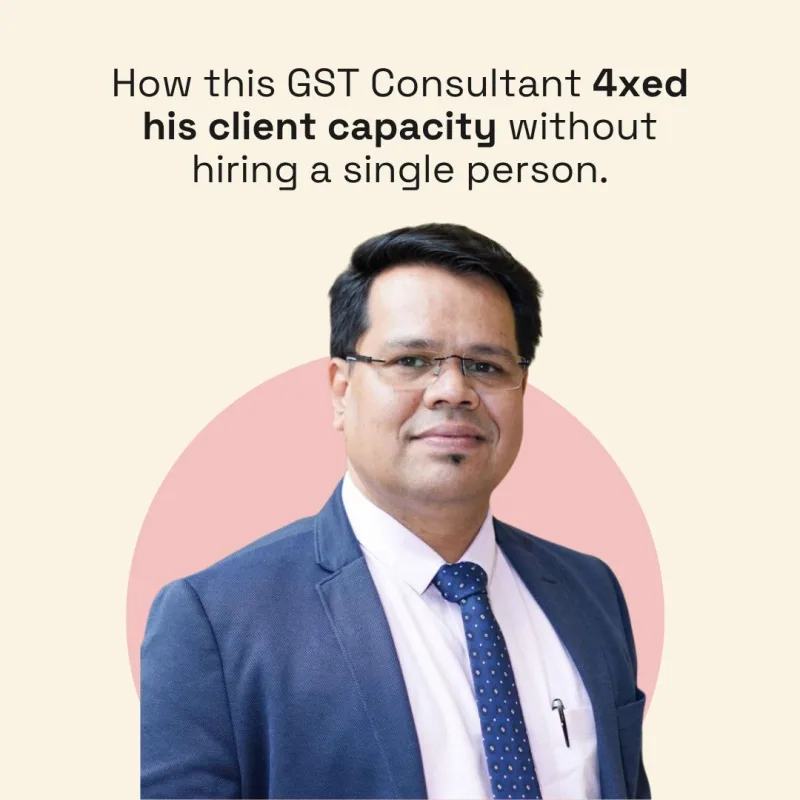
Prakash Patil is a GST consultant. Until last month, his entire business ran on a single bottleneck, and it was not the client work. It was the report.
Every client visit produced seven to eight days of back-end work. Compiling observations. Mapping legal frameworks. Calculating exposure. Writing recommendations. Formatting everything to match his brand.
Seven to eight days of his most expensive time, for every single client. He now produces the same report in five minutes, and the number that changed as a result is not the one most people expect.
Why can't a good consultant take on more clients?
Quick Answer: Because the constraint is usually delivery, not demand. Prakash could handle two client visits a month, and that ceiling had nothing to do with finding clients. The back-end work behind each visit consumed seven to eight days, so the practice could only serve as many clients as he could write up.
Most advice aimed at consultants assumes the problem is the top of the funnel. Get more leads, get more visible, get better at selling.
That was not his problem. His was the other one, which is quieter and more expensive: work already won, waiting behind work already done.
Two client visits a month was the ceiling. Every hour spent assembling a report was an hour not spent in a client's office doing the thing clients actually pay for. And because the report is the deliverable, it could not be skipped or shortened.
That is the shape of the problem in almost every expertise business. The expert is the bottleneck, and the bottleneck is rarely the expertise. It is the documentation of the expertise.
Your first action: Work out your own ceiling. How many clients could you serve this month if delivery took half as long? If that number is meaningfully higher than what you serve today, your constraint is not marketing.
Can AI write a GST audit report?
Quick Answer: Yes, and this one does considerably more than summarise. It produces the observations, the legal framework, the business impact, the recommendations, a calculation of the client's exposure if they are non-compliant, and his own branded formatting. Seven to eight days of work, in five minutes.
The important detail is how much of the report it actually produces.
A summary would not have helped. A GST audit report is not a document you skim, it is one a client acts on. It has to carry the observation, the legal framework it rests on, what it means commercially, what he recommends doing about it, and the exposure the client is carrying if they are non-compliant.
All of that now comes out of a single Claude skill he built, formatted and branded as his practice sends it.
He did not automate the client visit. He automated the work that was stopping him from doing more client visits.
The distinction matters if you are trying to work out whether this applies to you. Look at what you produce after the thinking is finished. If the write-up takes longer than the work, that gap is the opportunity.
Your first action: Time your last deliverable honestly, separating the thinking from the writing up. Most professionals have never measured the two apart, and the ratio surprises them.
Does AI replace professional judgement here?
Quick Answer: No. What got automated was the back-end work behind the visit, not the visit itself. The expertise is the same expertise; it was written down once so it could be executed repeatedly.
This is the question every professional asks, and it deserves a straight answer rather than reassurance.
The judgement in a GST audit is the whole product. Which transactions to question, which exposures matter, what the law says on a particular set of facts, and what a client should do about it. That is what the client is buying, and it is what the client visit is for.
What changed is the seven to eight days spent turning findings into a document that reads like a professional firm produced it. Assembling, formatting, cross-referencing, calculating and laying out. Work that requires care, and none of which requires the consultant personally.
There is also a reason this is the right boundary commercially, not just ethically. If the judgement were automated, the practice would have nothing left to sell. Automating the write-up makes the judgement more available, which is the opposite problem.
Your first action: Draw the line before you build anything. Write down which decisions in your work are the product, and treat everything on the other side of that line as fair game.
What is a Claude skill, and why not just use a prompt?
Quick Answer: A prompt is a request you make each time. A skill is a procedure written down once, that runs the same way every time. For a report carrying legal frameworks and exposure calculations, consistency is the whole point, and a prompt typed fresh each time cannot give you that.
This report is not a one-off piece of writing. It is the same document, correctly, for every client.
That is what a prompt is bad at. Type it again next month and you will phrase it differently, forget a section, or get a different structure back. For a birthday message, fine. For a document that carries a legal framework and calculates a client's exposure, that variance is the risk.
Writing it as a skill means the structure, the sections, the legal framing, the calculation method and the formatting are all fixed. He supplies the findings. The procedure does the rest, identically, every time.
The general form: if you do something once, prompt it. If you do it repeatedly and it has to come out the same way, write it down as a skill.
Your first action: Take the thing you have re-prompted more than five times and write it down properly once, with the structure and standards baked in.
What actually changed in the practice?
Quick Answer: Throughput. Two client visits a month became two client visits a week, every one of them billable. That is roughly four times the revenue capacity from a single skill. No new hires, no new tools, no new marketing.
This is the part worth sitting with, because it is not the number people expect from an AI story.
He did not get faster at winning clients. He built one thing, and the work he could already win stopped queueing behind the work he had already done.
Two client visits a month became two client visits a week. Every one of them billable, because the visit is the billable part and the report was never what a client was paying for.
One caution on reading this: four times the capacity is not automatically four times the revenue. Capacity is the ceiling, and filling it is a separate job. What the build removed was the reason he could not have grown even if the clients were queueing at the door.
Your first action: If you free up delivery capacity, decide in advance what fills it. Capacity nobody books is just a shorter working week, which is a fine outcome only if you chose it.
FAQ
Does this work for chartered accountants and auditors outside GST?
The specific report is a GST audit, but nothing about the approach depends on that. Any practice whose deliverable is a structured document built from expert findings has the same shape: tax, statutory audit, due diligence, compliance reviews, legal opinions.
What exactly did he build?
One Claude skill. Not a team, not a stack of tools, not a new funnel. A single procedure that turns his findings into the finished, branded report.
Is the output safe to send to a client?
The skill produces the document; the professional responsibility for it does not move. Any consultant using AI on client deliverables and not reading them before they go out has made a different and much worse decision.
Do I need to be technical to build a skill like this?
No. The hard part is describing your own procedure precisely, which is a subject-matter task rather than a technical one. If you can brief a competent junior on exactly how the report should be built, you can write a skill.
Can I verify this?
These figures were published on LinkedIn in a post about Prakash's build, which he saw and responded to publicly.
If you want to work out where this would start in your practice, book a call. For a case with three systems rather than one, read what a 64-year-old contractor built.