Somewhere this week, a founder you have never met opened ChatGPT and typed: "Who should I hire to fix my LinkedIn lead generation?" The answer came back in eight seconds. Three names, a one-line case for each, and a recommendation. A conversation you were never part of just decided whether you exist.
If you sell expertise, this is the new front door. You spent years earning referrals and building a content habit, and none of it matters in that window if the machine does not know what you are for. The shortlist gets drafted before anyone visits your profile.
This edition shows you how to become the answer instead of the omission. The urgency is not hypothetical: per Forrester's B2B buyer research, 72% of B2B software buyers now consult ChatGPT during vendor evaluation (reported by MarketScale, 12 July 2026). Sit this one out and you are competing for the shrinking share of buyers who still search the old way.
Where Do Buyers Actually Look for an Expert in 2026?
Quick Answer: Increasingly, inside AI assistants before they ever reach your profile. G2's The Answer Economy report (March 2026, a survey of 1,076 B2B software buyers) found 51% now start their research in an AI chatbot rather than a search engine, and 69% ended up choosing a different vendor than the one they first had in mind.
Read that second number again. The buyer arrived with a name in their head, asked the machine, and the machine changed their mind. A third of them bought from a vendor they had never heard of before the chatbot mentioned it.
Trust compounds the shift. Edelman's 2026 research (via the same MarketScale report) found buyers are 3.4 times more likely to trust a vendor cited by an AI answer than one they met through paid advertising. An AI citation reads as a neutral referral. An advert reads as an interruption.
Your first action: open ChatGPT, Claude and Perplexity, and type the exact question your ideal client would ask, in their words, not yours. Note whether you appear. That is your baseline.
Why Does LinkedIn Matter More Than Anywhere Else You Publish?
Quick Answer: Because the machines are already reading it. Semrush's study of 230,000 prompts (October 2025) found LinkedIn the second most-cited domain in LLM responses, behind only Reddit and ahead of Wikipedia. Your posts are not just content for the feed. They are raw material an answer engine can quote when a buyer asks who to hire.
Sit with that ordering for a moment. Reddit leads because it is an enormous public archive of people answering each other's questions in plain language. LinkedIn is second because it is the largest public library of professional expertise written by named humans with checkable credentials. Every post you publish is a candidate answer in that library.
That cuts both ways. The domain authority is already earned and you borrow it the moment you publish, which is leverage most founders never count. But the platform gets you considered, not quoted. What decides whether your paragraph is the one lifted into an answer is the shape of what you wrote, and that is where almost everyone loses the advantage they were handed.
I wrote the full mechanical playbook for this in an earlier edition: How to Optimize Your LinkedIn Content for AI Search in 2026. That edition is the how. This one is the why and the proof: what buyers are actually doing, and what 90 days of my own data says about the content shape that survives it.
Your first action: open the best post you published this month and reread it as a machine would. If no single paragraph can be lifted out and still make sense, you are publishing on the second most-cited domain in AI and getting none of the benefit.
Why Does AI Quote Some Founders and Ignore the Rest?
Quick Answer: Answer engines cite content that resolves one specific question in one standalone block: a question up top, a direct answer within the first 40 to 60 words, a number, a named source, a date. Content that needs surrounding context to make sense cannot be lifted, so it never gets quoted, however good it is.
The scale of the miss is stark. Crackle PR's Q2 2026 AI Citation Benchmark found 51% of B2B tech brands have zero citations across ChatGPT, Perplexity and Gemini (reported by MarketScale, 12 July 2026). Half the market is simply not in the library.
Most founders are invisible for a mundane reason. Their content is built for the scroll: a story, a build-up, a punchline. Humans enjoy that. A machine hunting for a quotable answer finds nothing it can extract, because every paragraph leans on the one before it.
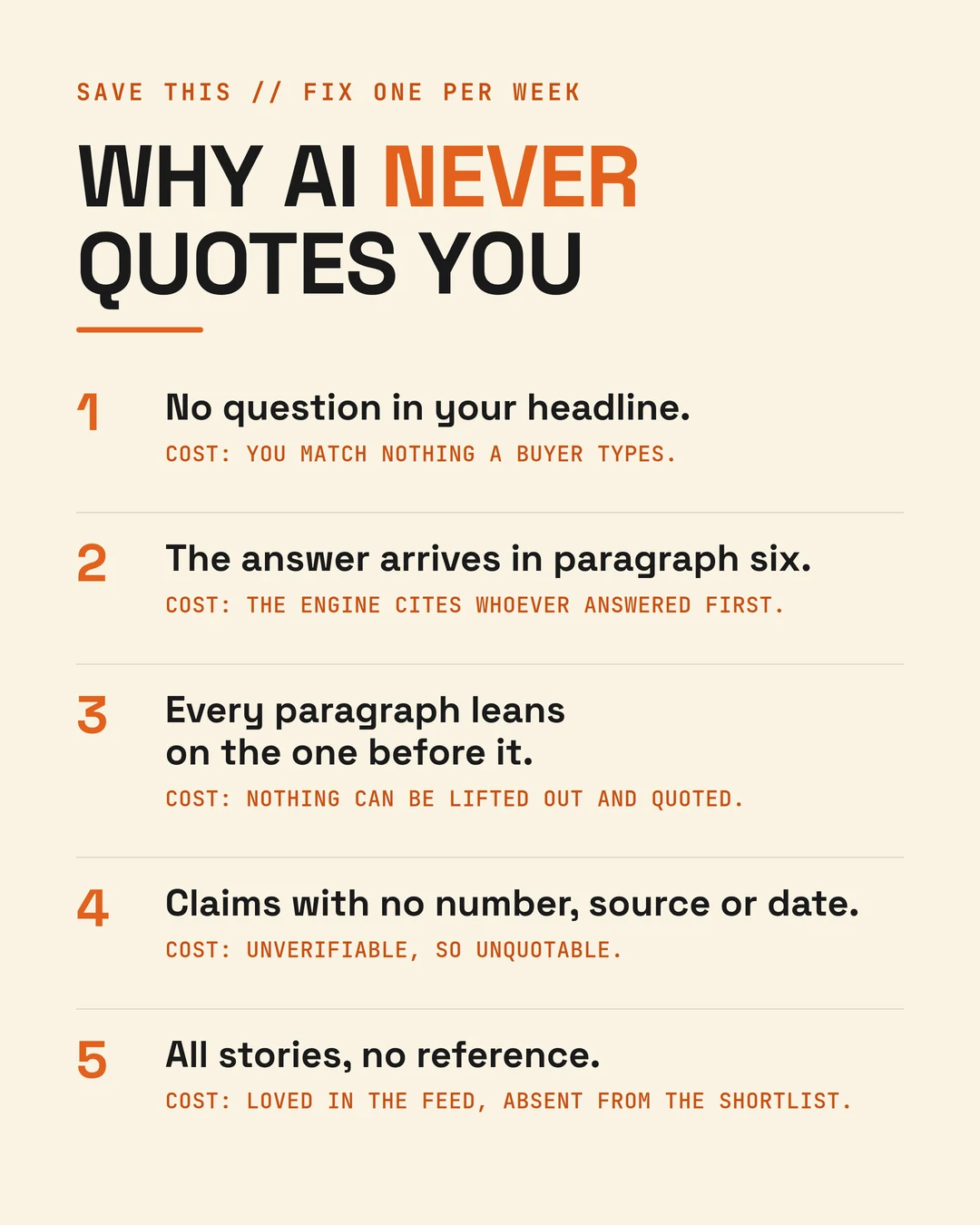
The fix is the standalone paragraph rule. Write every paragraph so it makes complete sense with zero surrounding context. When an AI cites you, it takes one paragraph, not your full piece. Each paragraph is either a complete thought or a wasted opportunity.
Your first action: take your best-performing post from last month and rewrite the first two lines as a question and a direct answer. Keep the story; move it below the answer.
What Do 90 Days of My Own Numbers Say About Reference Content?
Quick Answer: I checked my last 90 days on LinkedIn before writing this: 63 published posts, and only 13 earned a single save. The saved posts travelled roughly 3.5 times further than the posts nobody saved. Six of my eight most-saved posts share one shape: an itemised system a reader can follow without me in the room.
One honest caveat, because this is where most LinkedIn advice cheats. Saves do not force reach. The same quality that makes a post worth saving also makes it worth showing to more people, so the two travel together. Treat the 3.5x as a signal of what readers value, not a lever you pull.
Here is the nuance that stopped me over-correcting: my single biggest post of the quarter was a personal story, and it collected almost no saves. Stories recruit your audience. Itemised reference content is what gets saved by humans and retrieved by machines. A calendar built only on one of them is leaving money on the table either way.
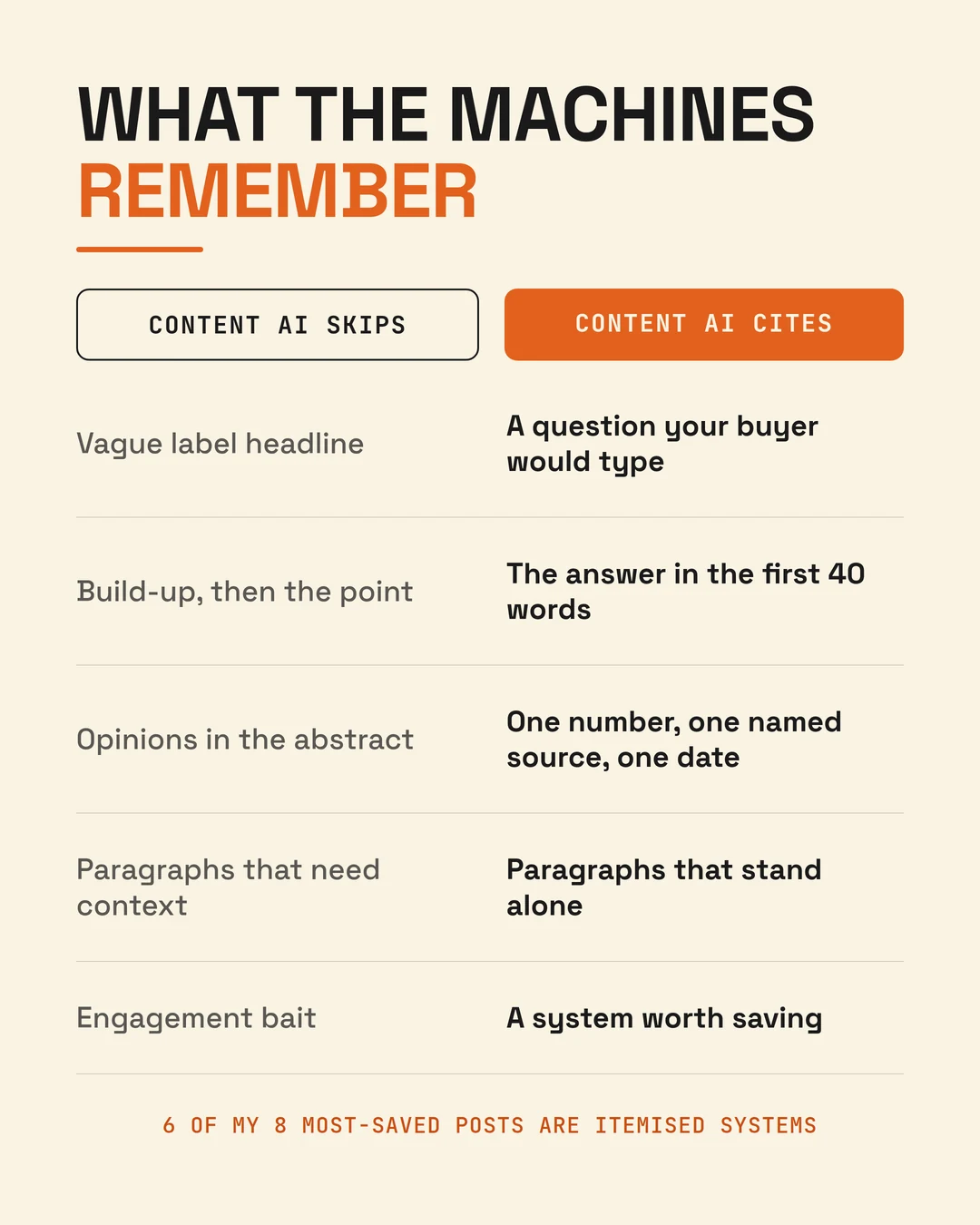
Reference content also matches how the machines shop. A saveable checklist and a citable answer are the same artefact: specific, self-contained, dated, worth returning to. Write for the save and you have written for the citation.
Your first action: take the question a client actually asked you this week and answer it as a numbered system, each step one standalone line. That post is doing double duty: feed value today, retrieval value for months.
How Do You Make One Post Citable This Week?
Quick Answer: Five moves. Write the headline as the question your buyer would type. Put the answer in the first 40 words. Include one number with a named source and a date. Define any term of art in the sentence where it first appears. Then give the long version a permanent home in a newsletter or article, because a post that scrolls away is hard to cite.
None of this requires abandoning your voice. It requires sequencing: answer first, story second. The founders who win the next two years of AI search will mostly be the ones who showed up in the library early, and the lag is real: Crackle PR measured a median of 68 days between a placement and its appearance in AI answers (via MarketScale). What you publish this week is your November visibility.
Your first action: take tomorrow's post and run it through all five moves before you hit publish. Seven minutes, once, and you will feel the difference in how it reads.
FAQ
How do consultants get cited by ChatGPT and Claude when buyers ask for experts?
Publish content that answers one specific buyer question per piece, with the direct answer in the first 40 words, a number, a named source and a date. Give it a permanent, indexable home such as a newsletter or article, and keep it current, because answer engines favour fresh, dated, standalone material.
Should founders stop writing story posts on LinkedIn?
No. In my own last 90 days, my biggest post was a personal story, while my most-saved posts were itemised systems. Stories recruit your audience and build trust; reference content gets saved, quoted and retrieved. A working content calendar carries both on purpose.
How long does it take to show up in AI search answers?
Expect a lag. Crackle PR's Q2 2026 benchmark measured a median of 68 days between a media placement and its appearance in LLM answers. Treat AI visibility like SEO in 2010: the compounding favours whoever starts now, not whoever starts loudest.
Which websites do AI models cite most when recommending experts?
Reddit and LinkedIn lead. Semrush's October 2025 study of 230,000 prompts found Reddit the most-cited domain in LLM responses, with LinkedIn second and Wikipedia third. For anyone who sells professional expertise, that makes LinkedIn the highest-leverage place to publish a citable answer, provided the post is written in a shape a machine can actually lift and quote.
Is AI search really where B2B buyers make decisions in 2026?
The evidence says yes. Forrester found 72% of B2B software buyers consult ChatGPT during vendor evaluation, and G2 found 51% start their research in an AI chatbot, with 69% switching from their originally intended vendor after AI guidance. The shortlist is being drafted before you ever get a call.
Three ways I can help when you are ready
- Score your LinkedIn growth. Three minutes, 18 questions, and you know the one thing costing you clients: the scorecard
- 25 lead-gen prompts. What I use daily to book calls, not collect likes: get the prompts
- Titan AI Business Mastery. Build your AI operating system and take back 20+ hours a week: see the programme